
Constitutional Redistricting Provisions
Introduction
Constitutional Background to Congressional and Legislative Redistricting
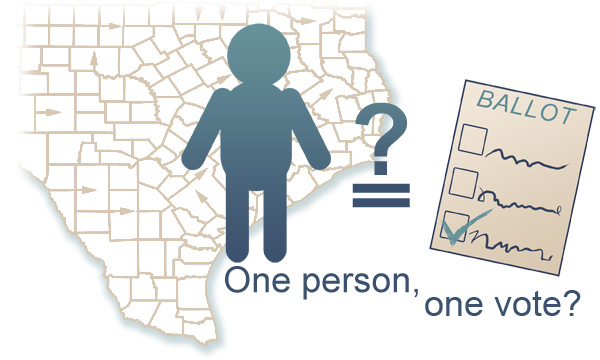
The American system of representative democracy rests primarily on the concept of equal representation in legislative bodies. This means using some mechanism that ensures that each member of such lawmaking bodies represents approximately the same number of people.
On the national level, equal representation is required only for the House of Representatives (every state is apportioned exactly two seats in the U.S. Senate). Additionally, all of the state legislatures require that the seats are apportioned to districts having roughly the same population.
How do we ensure equality of representation? We do this by counting periodically – every ten years in the decennial census of the population – all of the people in every state, in every county, and on every street. Then we (rather, our elected representatives in the state legislatures) redraw the lines of the congressional and the state legislative districts within each state.
Of course, the state legislatures must follow all of the rules established by the U.S. Constitution and their respective state constitutions regarding how such districts can be drawn. The problem is that there aren't very many rules that must be followed. And the ones that do exist aren't very detailed. This opens the door to considerable, let us say, creativity (some call it gerrymandering) when drawing the shapes of congressional and state legislative districts.
U.S. Constitution
The U.S. Constitution and Redistricting
The Constitution of the United States specifies the apportionment of seats of the House of Representatives to the various states on the basis of each state's population (for the upper chamber, the Senate, each state is apportioned exactly two seats each). The U.S. Constitution says nothing about drawing districts for the individual state legislatures.
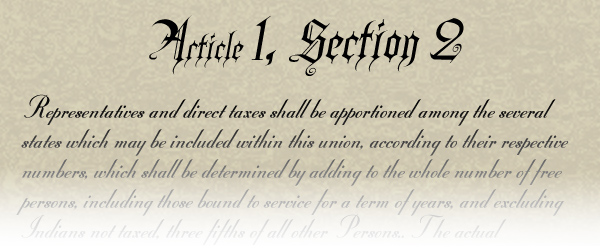
Representatives and direct taxes shall be apportioned among the several states which may be included within this union, according to their respective numbers... [Article I, section 2]
Of course, you have to know how many people actually live in the various states, and you have to be sure to update those numbers on a periodic basis because of population changes. That's why Article I (the legislative article) of the Constitution requires that a census of the population be conducted every ten years. It states:
The actual Enumeration [of the population] shall be made within three years after the first meeting of the Congress of the United States, and within every subsequent term of ten years, in such manner as they shall by law direct. [Article I, section 2]
Despite requiring reapportionment after each decennial census of the population, the Constitution is silent on the actual process of redrawing districts for the U.S House of Representatives (or for districts for the state legislatures). Admired for its brevity and flexibility, the Constitution says this about the election of members of Congress:
The times, places and manner of holding elections for Senators and Representatives, shall be prescribed in each state by the legislature thereof; but the Congress may at any time by law make or alter such regulations, except as to the places of choosing Senators. [Article I, section 4]
It is of little wonder, then, that politicians have tried to rig the process and the outcomes of redistricting since the founding of the Republic. Indeed, the term gerrymander (drawing legislative districts to maximize political goals at the expense of all other considerations) was coined in 1812, when our new country was still in its infancy.
Over the years, particularly in the post-Civil Rights era, the U.S. Supreme Court and the Department of Justice have placed restrictions on the redrawing of congressional and legislative districts to protect the representation of racial and ethnic minorities (see minority vote concentration and minority vote dilution in the glossary). Despite these, the practice of drawing districts for political advantage has not been fundamentally challenged.
Source: Cornell University, Legal Information Institute, http://www.law.cornell.edu/constitution/constitution.overview.html, provides full text of the Constitution of the United States with amendments, searchable by article and section, and by amendments.
Texas Constitution
The Texas Constitution and Redistricting
The Texas Constitution provides many more details in its specification of government structure and procedures than does the U.S. Constitution. This is not surprising given that the state document in its original form was almost fifteen times as long as its counterpart on the national level.
So, it seems natural that it would provide more specific rules on how to draw legislative and congressional districts than the U.S. Constitution. Despite the added coverage, however, the limited nature of these additional redistricting rules is striking.
Let's zoom in.
The main article in the Texas Constitution that specifies the Legislative Department (Article 3) identifies a few specific characteristics required of all legislative districts (it is silent on congressional districts). The state constitution identifies really only two requirements with regard to the shape and boundaries of state legislative districts: contiguity and preservation of the integrity of counties (where possible).
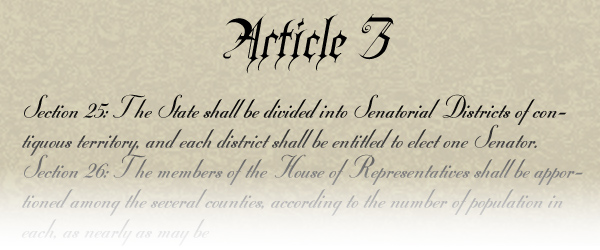
First we have the section title "Senatorial Districts" (Article 3, section 25), which spanning just twenty-one words requires only that the territory of senatorial districts be contiguous: "The State shall be divided into Senatorial Districts of contiguous territory, and each district shall be entitled to elect one Senator."
The section on districts for the House of Representatives (Article 3, section 26) is notably much more detailed. Indeed, even the section title is more descriptive: "Apportionment of Members of House of Representatives."
In addition to specifying that the territory of House districts be contiguous, the framers added language that requires keeping whole counties intact when drawing district lines.
[W]henever a single county has sufficient population to be entitled to a Representative, such county shall be formed into a separate Representative District, and when two or more counties are required to make up the ratio of representation, such counties shall be contiguous to each other; and when any one county has more than sufficient population to be entitled to one or more Representatives, such Representative or Representatives shall be apportioned to such county, and for any surplus of population it may be joined in a Representative District with any other contiguous county or counties.
So, that's it: contiguity and preserving the integrity of counties where possible. Although these requirements say much more about how legislative districts must be drawn than anything in the U.S. Constitution, they still leave much room for the creative musings of our state legislators. The rules do matter, and they must be respected. But sometimes it is difficult to devise rules for something as complex as redistricting.