
Voting Rules and Election Outcomes
Voting Rules and Election Outcomes
Elections are complex events. We often assume that simple majority rule is a simple approach to popular democratic government. But, as this chapter shows, many forces can affect election outcomes. Election results can be shaped by almost everything – from the partisan leanings of voters to candidates' qualities to campaign issues and advertising to voter turnout to election administration.
The voting rule used also affects election outcomes. In its simplest sense a voting rule is the minimum number of members of a group who must agree on a candidate or course of action to select it for the group. Examples include:
- Unanimity: choose the option all group members prefer
- Simple majority rule: choose the option at least one half plus one group members prefer
- Dictatorship: choose the option a single person in the group prefers
A rule of unanimity is extremely difficult to satisfy most of the time. Dictatorship unchecked is undesirable. Simple majority rule seems the most workable and fairest choice for popular elections.
Not So Simple Majorities
As a matter of practice, though, we don't much use simple majority rule in American elections. Instead we use plurality rule – often termed "winner-take-all" or "first-past-the-post" voting – where the winner is the candidate or alternative that receives more votes than any other. In circumstances where the choice is between two alternatives – represented in the U.S. by the two major parties – plurality rule usually gives the same results as simple majority rule. But not always.
More generally, the question of which voting procedure is best involves questions of fairness. The phrase "one person, one vote" encapsulates a core idea of procedural fairness. But, given procedural fairness, what's a fair way to add up votes to determine social choices, particularly when we allow for more than two alternatives?
In general, we believe that the candidate with the most support should win. But what is the fairest way to judge support? There is no simple answer. Simple majority rule and plurality rule consider only each voter's top choice ignoring lower ranking choices. Variations on simple majority and plurality voting called full preference voting rules attempt to take into account each voter's second, third, and fourth choices, and so on among a list of candidates. As we shall see, different voting procedures – many arguably as or more fair than simple majority rule – can produce very different outcomes, even when used by the same group of voters to decide among the same list of candidates.
Voting Procedures Briefly Explained
Students of voting have devised many carefully considered ways to democratically sum up voters' preferences. Majoritarian methods apply or extend simple majority rule to two or more alternatives. Positional methods take into account some or all information about voter preferences. Some positional methods consider voters' first choices only (e.g., plurality voting). Some account for multiple but incomplete expressions of voters' preferences (e.g., approval voting). Some use voters' full rankings of all alternatives (e.g., scoring methods like the Borda count). [1] The table describes some important examples:
| Majoritarian Methods |
|
Simple Majority Rule
|
|
Condorcet Method (Pairwise Comparison) [2]
|
| Positional Methods |
|
Plurality Rule
|
|
Instant Runoff
|
|
Borda Count [3]
|
|
Approval Voting
|
A Simple Example
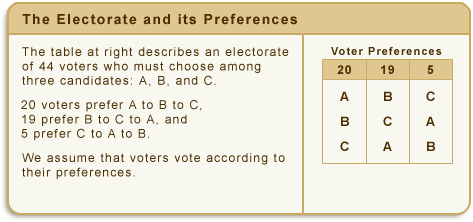
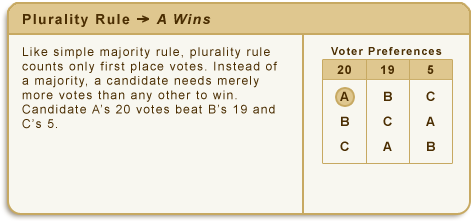
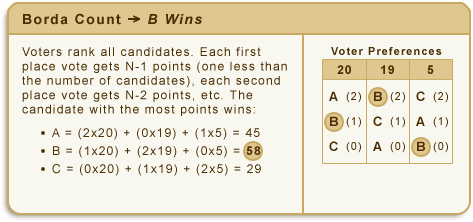
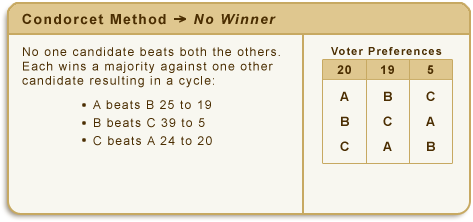
To see that the choice of voting procedures can alter election outcomes consider the simple example described below.
Simple Majority:
Plurality Rule:
Borda Count:
Condorcet Method:
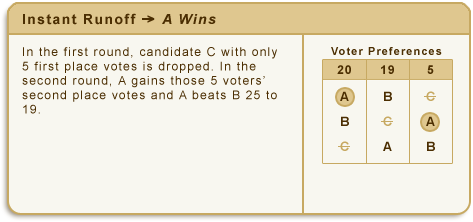
Instant Runoff:
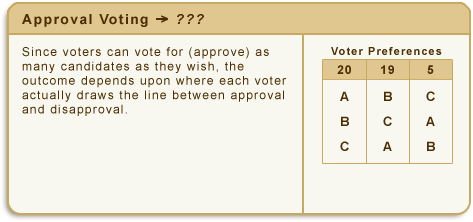
Approval Voting:
The 1860 Presidential Election: A Real World Example
In real elections with more than two alternatives, as in made-up examples, different voting procedures can surprisingly often lead to dramatically different outcomes. The 1860 presidential election provides a real-world example.
Lincoln today is usually ranked among the greatest presidents. In 1860, though, he was an extraordinarily polarizing figure, popular with many in the North but abhorred in the South. Douglas, Lincoln's closest competitor, was widely popular. As the popular vote shows, Lincoln won more first place votes than Douglas. But according to historians Douglas was nearly everyone's second choice. Douglas, according to a recent study, would have won using almost any procedure other than plurality rule.[4]
| Candidate | Party | % Popular Vote | Electoral College Votes |
% Electoral College Vote |
|---|---|---|---|---|
| Abraham Lincoln | Republican | 39.8 | 180 | 59.4 |
| John Breckenridge | Southern Democratic | 18.1 | 72 | 23.8 |
| John Bell | Constitutional Union | 12.6 | 39 | 12.9 |
| Stephen Douglas | Democratic | 29.5 | 12 | 4.0 |
Sources
1. A third class, utilitarian methods, attempts to account for voters' intensity of judgments about or direct valuations of all candidates. These are more complicated and much less often used than the methods discussed. See Riker (1982) for further details.
2. The Marquis de Condorcet (1743-1794), like his contemporary Borda, was a French nobleman and mathematician. For a brief introduction see http://www.history.mcs.st-and.ac.uk/history/Mathematicians/Condorcet.html. Condorcet proposed pairwise comparison as a fair method of election with more than two candidates even though it might not produce a winner.
3. Jean Charles de Borda (1733-1799), like his contemporary Condorcet, was a French nobleman and mathematician who pursued a military career. For a brief introduction see http://www-history.mcs.st-and.ac.uk/history/Mathematicians/Borda.html. Borda countered Condorcet's method of fair elections with his own ranking system. He and Condorcet vigorously disputed the merits of their respective systems.
4. Tabarrok, A., and L. Spector. 1999. "Would the Borda count have avoided the Civil War?" Journal of Theoretical Politics 11: 261-88.