
Where in Texas are Indigenous Groups?
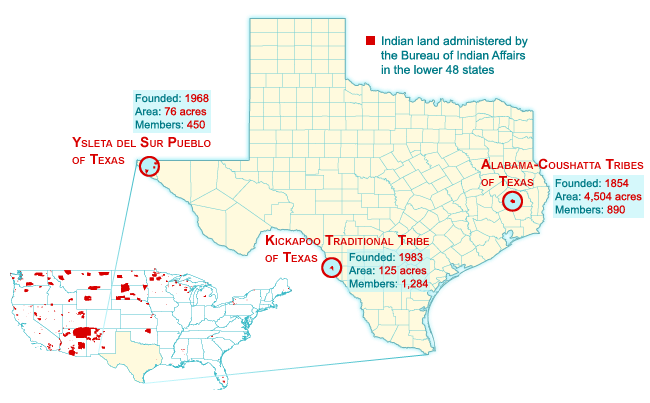
Unlike most western states, Texas today has almost no Indian lands, the result of systematic warfare by Texas and the United States against indigenious groups in the nineteenth century that decimated tribes or drove them onto reservations in other states.
While the limited number and size of Indian reservations in Texas today reveal much about relations between European-descended settlers and Indians at the turn of the 19th century, these reservations account for only a small percentage of the native Americans in the state. Though only about 2,624 people have formally enrolled as members of Texas tribes, the 2000 census counted 118,362 people in Texas who identified themselves as exclusively American Indian or Alaska Native (AIAN).
Source: For a thorough summary of Texas tribes today see: "Texas." Economic Development Administration, U.S. Department of Commerce, http://www.eda.gov/ImageCache/EDAPublic/documents/pdfdocs/39texas_2epdf/v1/39texas.pdf (July 6, 2006).
Detailed census information is available from the Bureau of the Census, http://factfinder.census.gov/home/aian/index.html (July 6, 2006).
See the Handbook of Texas Online for detailed historical information on the Alabama-Coushatta Tribes of Texas, http://www.tsha.utexas.edu/handbook/online/articles/AA/bma19.html (July 6, 2006); the Kickapoo Traditional Tribe of Texas, http://www.tsha.utexas.edu/handbook/online/articles/KK/bmk9.html (July 6, 2006); the Tiguas at Ysleta Del Sur Pueblo of Texas, http://www.tsha.utexas.edu/handbook/online/articles/TT/bmt45.html (July 6, 2006). See also the entries in the Handbook on Indians, http://www.tsha.utexas.edu/handbook/online/articles/II/bzi4.html (July 7, 2006) and on the Comanche Indians, http://www.tsha.utexas.edu/handbook/online/articles/CC/bmc72.html (July 7, 2006).